How to Use the Facebook Split Testing Feature to Identify Your Most Profitable Audiences

Do you want to improve your Facebook ads? Wondering how the Facebook split test audience variable feature can help? In this article, you’ll discover how to split test audiences and reveal which ones deliver the best results for your Facebook ad campaigns. What Is the Facebook Split Testing Feature? The Facebook split testing feature lets […]

The post How to Use the Facebook Split Testing Feature to Identify Your Most Profitable Audiences appeared first on Social Media Examiner.

Read More

Why Offline Word of Mouth is More Persuasive than Online Word of Mouth

Americans value offline word of mouth recommendations 41% more than online word of mouth. #ChatterMatters
Click To Tweet

The number of the day today is 41. 

41 is the name of a great Dave Matthews Band song. It is the atomic number of niobium. The longest and last symphony written by Mozart is Symphony No 41. And it’s the Guinness World Record for the most peopled crammed into a large car, achieved in 2015 in Krasnoyarsk, Russia. In case you are wondering, they crammed into a Toyota Rav4. 

The number 41 is relevant to word of mouth marketing. Let me explain.

When it comes to getting recommendations on what to buy, we rely on both online word of mouth—like social media and review sites—and offline word of mouth—suggestions from our friends and family. When you compare online and offline word of mouth, the overall volume of conversation is similar, but offline word of mouth is more persuasive. According to our word of mouth report, Chatter Matters, Americans value offline word of mouth 41% more than online word of mouth.

There is a corner of the business world that believes social media IS word of mouth, or that social media has replaced word of mouth as the driver of consumer awareness and … Read More

How to Take Your Content Marketing from Data Reactive to Data Driven

You’ve been told over and over that content marketing needs to be data driven.

You’ve been told that you need to prove ROI. To show the business impact of what you do. To measure everything back to dollars and cents so you can make your case to the executive team.

While tying your efforts back to ROI is incredibly important, your efforts at utilizing data shouldn’t stop there. Being data-driven doesn’t mean just showing value. It means using data to give your organization a competitive advantage against even the biggest, burliest of competitors.

Being data driven means using data to give your organization a competitive advantage against even the biggest, burliest of competitors.
Click To Tweet

In practice, it means understanding what campaigns will succeed before they are even created. 

Imagine that: no more trial and error and wasting months to figure out if your audience even cares about the content you’re creating. 

Sound appealing? Great. Let’s dive into how to make it happen.

This is not data-driven content marketing.

Having solid numbers at the end of a campaign to show your executive team feels like a win for being data-driven. But, unfortunately, this isn’t being data driven. It’s being data reactive.

How Does Comcast Tell 29 Million People About Customer Experience Transformation?

The team at Convince & Convert and I have been working with Comcast for nearly two years, helping them understand the landscape of customer experience influencers, and how that community thinks about CX transformation and storytelling.

Last week, as part of that work, I was joined at the Comcast headquarters in Philly by a cavalcade of all-star customer experience thinkers: Chip Bell, Jeanne Bliss, Joey Coleman, Steve Curtin, John Dijulius, Matt Dixon, Moira Dorsey, Shep Hyken, Scott McKain, Adam Toporek, Bill Quiseng, and Jeannie Walters.

We gathered together to spend an entire day behind the scenes with Comcast executive leadership, including Chief Customer Experience Officer Charlie Herrin, discussing the commitment the company has made to turn around a customer experience that has historically been far less than optimal.

The company has invested hundreds of millions of dollars, embarked on the largest Net Promoter Score implementation in history, and has made more than one million customer callbacks in just the first 10 months of 2018. (Every manager in the company, regardless of role, is now required to call actual customers on a regular basis).

The commitment made to this transformation is… Read More
Can You Still Use Infographics to Build Links?

Posted by DarrenKingman

Content link building: Are infographics still the highest ROI format?

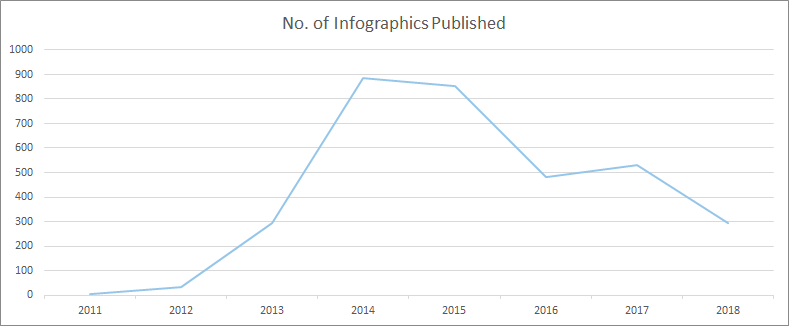
Fun fact: the first article to appear online proclaiming that “infographics are dead” appeared in 2011. Yet, here we are.

For those of you looking for a quick answer to this strategy-defining question, infographics aren’t as popular as they were between 2014 and 2015. Although they were the best format for generating links, popular publications aren’t using them as often as they used to, as evidenced in this research. However, they are still being used daily and gaining amazing placements and links for their creators — and the data shows, they are already more popular in 2018 than they were in 2013.

However, if there’s one format you want to be working with, use surveys.

Note: I am at the mercy of the publication I’ve reviewed as to what constitutes their definition of an infographic in order to get this data at scale. However, throughout my research, this would typically include a relatively long text- and data-heavy visualization of a specific topic.

The truth is that infographics are still one of the most-used formats for building links and brand awareness, and from my outreach experiences, with good reason. Good static visuals or illustrations (as we now call them to avoid the industry-self-inflicted shame) are often rich in content with engaging visuals that are extremely easy for journalists to write about and embed, something to wh… Read More